

ChatGPT vs Claude for writing: which one should you use? We ran the same three tasks in both tools and compared the real results.
Disclosure: This article may contain affiliate links. If you buy through them, we may earn a commission at no extra cost to you. This never affects our testing or verdicts. Claude is one of the two tools compared here, and this article was drafted with help from an AI assistant that is also Claude. To limit bias, we judge the results only on visible criteria, and we show the full prompts and outputs so you can check them yourself.
ChatGPT vs Claude for writing at a glance
Quick verdict: Both tools handled all three writing tasks correctly. The differences are in style, not in basic ability. In our tests Claude gave more structured and detailed answers, while ChatGPT gave shorter, easier-to-scan ones. Both added product claims we never asked for, so you should always check AI-written copy before you publish it.
- Tested on: October 21, 2026
- Versions: Claude Sonnet 5.5 and ChatGPT, both on their free plans (ChatGPT’s model name was not displayed)
- Tasks: a product description, a rewrite, and a summary
- Best for: people who write every day and want to pick an assistant for editing and short copy
What we tested (and how)
We gave both tools the same three prompts, word for word, in a new chat each time. The tasks are small but common: writing short marketing copy, fixing a badly written sentence, and summarizing a longer text. We ran each prompt once, so treat this as a snapshot and not as a lab benchmark.
We judged the results on five simple questions:
- Did it follow the instructions (word count, number of bullets)?
- Did it add information we did not ask for?
- Did it keep the original meaning?
- Is the output short and easy to scan?
- Could you use it with little editing?
We do not give numeric scores. We show what each tool did and let you decide what matters for your work.
Test 1: Write a product description
Prompt:
Write a 100-word product description for a stainless steel water bottle that keeps drinks cold for 24 hours. Target audience: busy professionals. Tone: friendly and clear.What Claude did: It wrote exactly 100 words, plus a four-word headline (“Stay Cold All Day”), and split the text into short paragraphs. It also added concrete features we did not mention: a leak-proof lid, a wide mouth that fits ice cubes, and no metallic taste or odor.
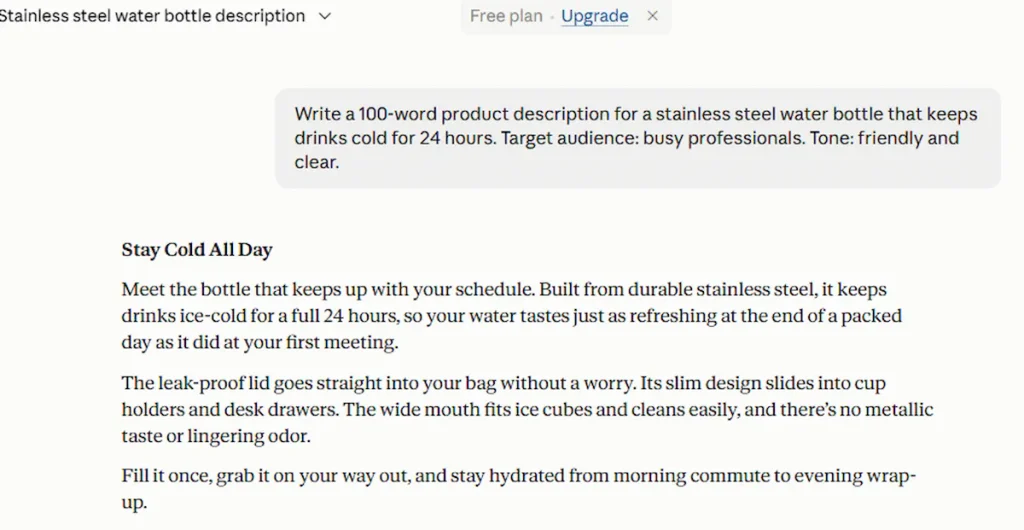
Claude Sonnet 5.5 result, tested October 21, 2026.What ChatGPT did: It wrote 99 words in a single paragraph with no headline. It stayed more general, but it still added claims such as “premium,” “advanced insulation,” and “sleek, modern design.”
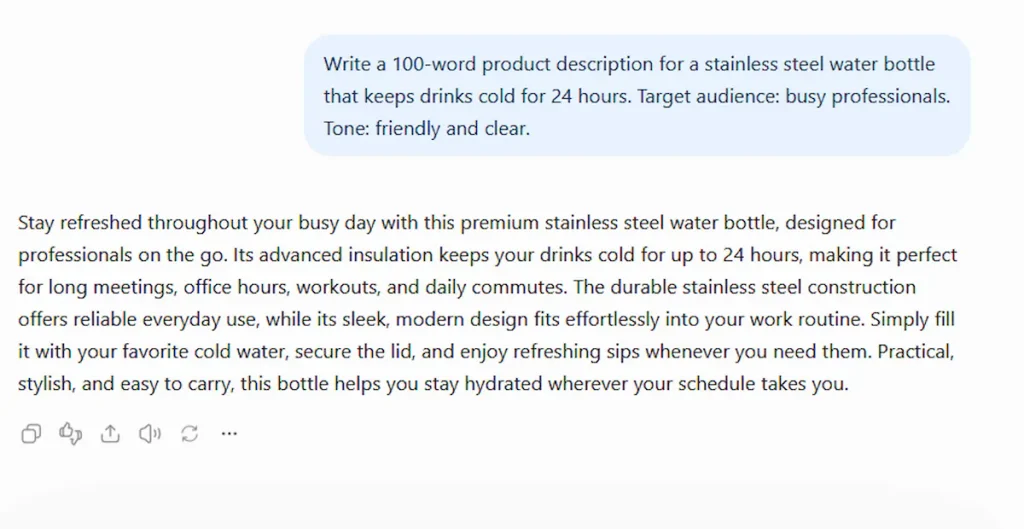
Takeaway: Both followed the length instruction. Both invented details about the product. If you sell a real bottle, you would have to remove or confirm every claim before using either text.
Test 2: Rewrite a poorly written paragraph
Prompt:
Rewrite this paragraph so it is clear and professional: “We was thinking that maybe our new tool could help you to save time on stuff you do every day, because it is doing many things automatic and you dont need to worry about much.”Claude’s result (31 words):
Our new tool is designed to save you time on your daily tasks. By automating many routine processes, it lets you focus on what matters most without worrying about the details.
Claude also offered to adjust the tone for a formal or a casual setting.
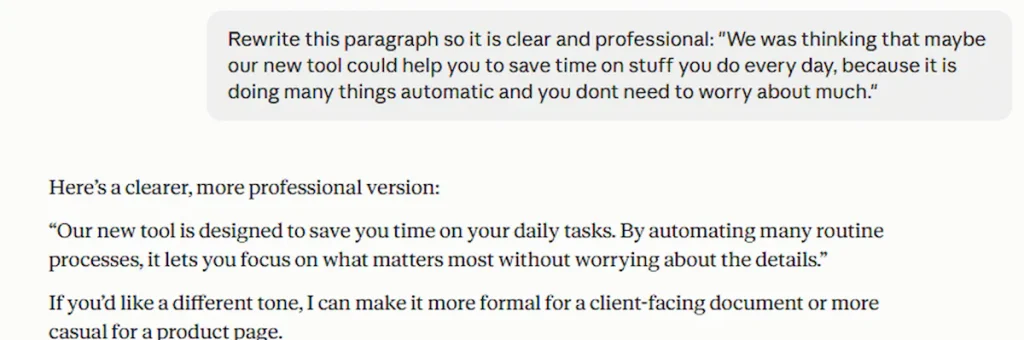
Claude Sonnet 5.5 result, tested October 21, 2026ChatGPT’s result (27 words):
We believe our new tool can help you save time on everyday tasks by automating many routine processes, allowing you to work more efficiently with less effort.
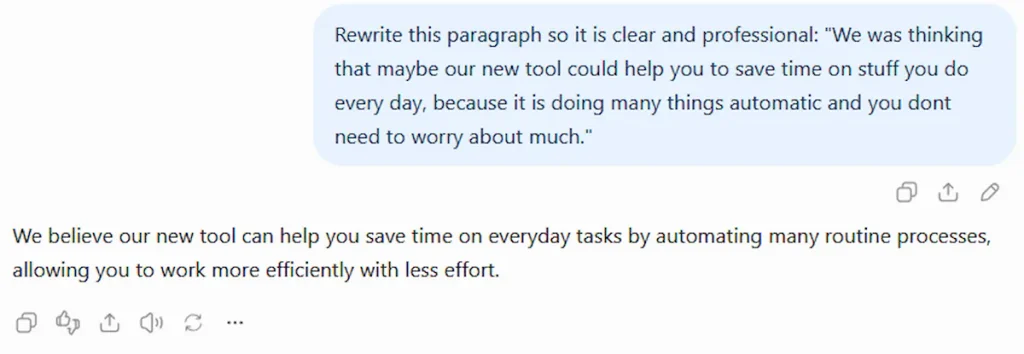
Takeaway: Both fixed the grammar and sounded professional. Claude kept the idea that the user does not need to worry, and added a new idea (“focus on what matters most”). ChatGPT kept the original “we” voice but dropped the “do not worry” idea. Which is better depends on whether you care more about voice or about keeping every point.
Test 3: Summarize a text in exactly three bullets
Prompt:
Summarize the text below in exactly three bullet points.We pasted a passage of about 300 words about choosing software tools for a small business.
Claude: Three bullets, 123 words in total (44, 47, and 32 words). The first bullet joined several ideas into one long sentence.
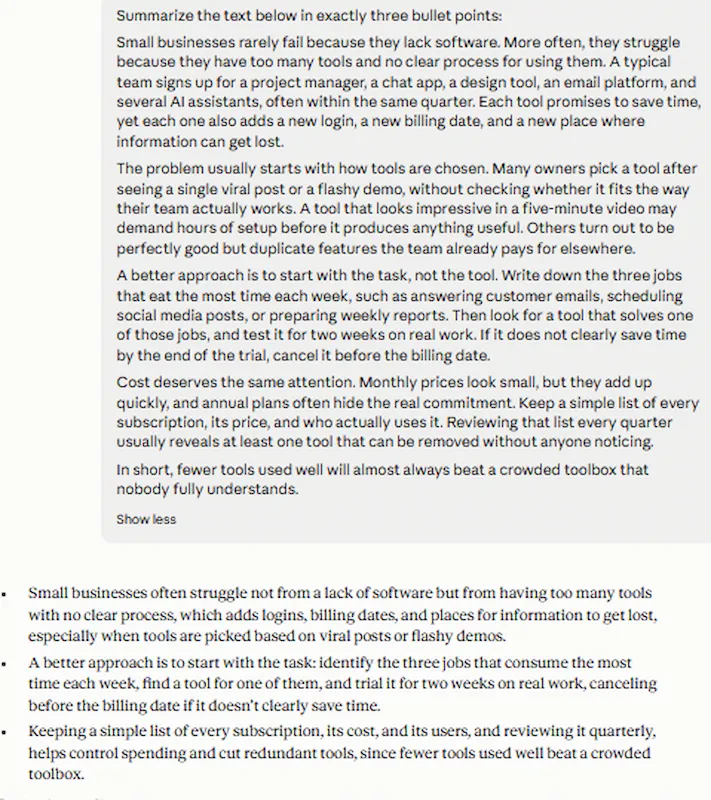
Claude Sonnet 5.5 result, tested October 21, 2026.ChatGPT: Three bullets, 74 words in total (21, 29, and 24 words). Each bullet started with a short label, which made the summary easy to scan.
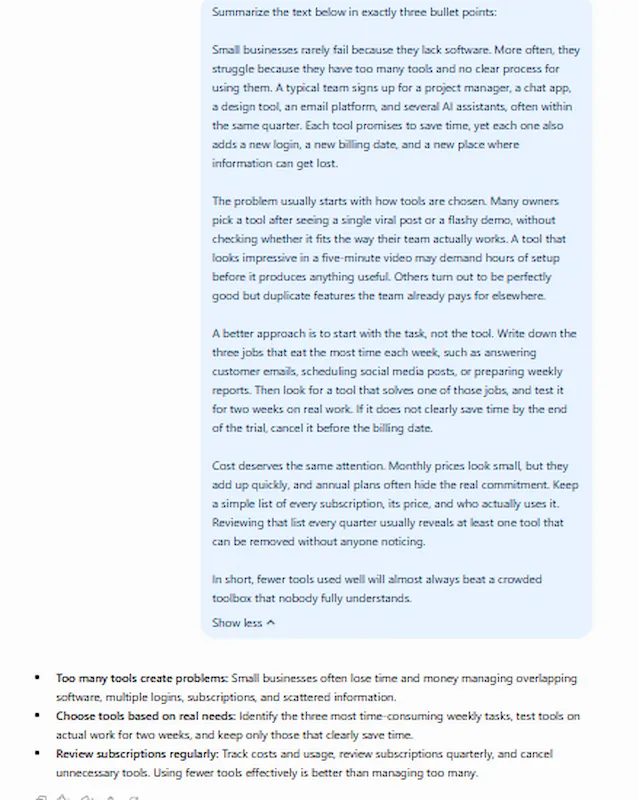
ChatGPT free plan result, tested October 21, 2026.Takeaway: Both followed the “exactly three bullets” rule. ChatGPT’s summary was shorter and easier to read quickly. Claude’s kept more detail but was heavier to read.
Results side by side
| What we checked | Claude (Sonnet 5.5) | ChatGPT (free plan) |
|---|---|---|
| Test 1 length | 100 words plus a 4-word headline | 99 words, no headline |
| Test 1 added details | Leak-proof lid, wide mouth, no metallic taste | “Premium,” “advanced insulation,” “sleek design” |
| Test 1 layout | Headline and short paragraphs | One paragraph |
| Test 2 length | 31 words, offered tone options | 27 words |
| Test 2 meaning | Kept “no need to worry,” added a new idea | Kept “we” voice, dropped “no need to worry” |
| Test 3 bullets | 3 bullets, 123 words | 3 bullets, 74 words |
| Test 3 readability | Longer, more detail | Shorter, labeled bullets |
Which one should you use?
Claude may suit you if you:
- Like structured drafts with more detail
- Want the tool to offer follow-up options, such as a change of tone
- Do not mind trimming longer answers
ChatGPT’s free plan may suit you if you:
- Prefer short answers you can scan in seconds
- Want compact summaries
- Are happy to ask for more detail when you need it
In both cases, the most important habit is the same: read the output and remove anything you cannot verify.
Limits of this test
- We ran each prompt once. AI answers change between runs, so your results may differ.
- We tested three short tasks. We did not test long articles, research, coding, or non-English writing.
- For this ChatGPT vs Claude for writing test, both tools were used on their free plans, but the underlying models may differ: we used Claude Sonnet 5.5, while ChatGPT’s model name was not displayed. Plans, models, and limits change often, so check the official ChatGPT and Claude websites before you choose.
- One of the tools compared is made by the same company as the assistant that helped draft this article. That is why we show every prompt and result.
Frequently asked questions
Is ChatGPT or Claude better for writing?
In our small test, neither was clearly better. Claude gave more structured and detailed answers, and ChatGPT gave shorter ones. The better choice depends on the kind of writing you do.
Can I use both tools together?
Yes. Many people draft in one tool and polish in another. For editing existing text, you can also read our Grammarly review.
Will I get the same results if I repeat these prompts?
Probably not exactly. AI tools produce slightly different answers each time, so run the prompts yourself on your own work before you decide.
Is it safe to publish AI-written copy as it is?
No. Both tools added claims we never provided. Always check facts, features, and numbers before publishing.
Final verdict: ChatGPT vs Claude for writing
Both tools are capable writing assistants for everyday tasks. If you want more detailed, structured answers, Claude is worth trying. If you prefer short, scannable output, ChatGPT’s free plan is a sensible place to start. Run the same three prompts on your own real work, because that is the fairest test of all.
For a wider look at your options, see our guide to the best AI writing tools in 2026, and our reviews of Jasper AI and Notion AI.
We tested both tools on October 21, 2026. Plans, models, and features change, so please verify current details on the official websites.